Series Circuits Worksheet Answers
Series Circuits Worksheet Answers - Add each resistor up to find resistance total i.e. Learn how to calculate the current, voltage and resistance in series and parallel circuits with this worksheet. Voltage drops across all resistors will add together to equal the total voltage resistance: The amount of energy used by a series circuit must equal the energy supplied by the battery.
Series And Parallel Circuits Worksheets With Answers
All the revision you need in one spot. Series/parallel circuits resolve the following problems and draw the schematic diagram for each problem. Take the series dc circuits practice worksheet with answers (basic electricity) worksheet.
Series And Parallel Circuits Electric Circuits An Electric Circuit Provides A Complete, Closed Path For An Electric Current.
It cannot flow through an open circuit. Calculate the amount of voltage dropped by each resistor, as well as the amount of power dissipated by each resistor: Series circuit worksheet #1 meets ase task:
Be Sure To Place A Box Around The Calculated Values Requested.
In a series circuit there is just one path so the charge flow is constant everywhere (charge is not lost or r gained). Determine the equivalent (total) resistance for each of the following circuits below. Complete the table by calculating the total resistance of the following series circuit.
Electricity Can Only Flow Through A Closed Circuit;
To answer the questions in the practice section, you will have to use ohm's law. Complete the table by calculating the total resistance of the following parallel circuit. In this way, electrical circuits follow the law of conservation of energy.
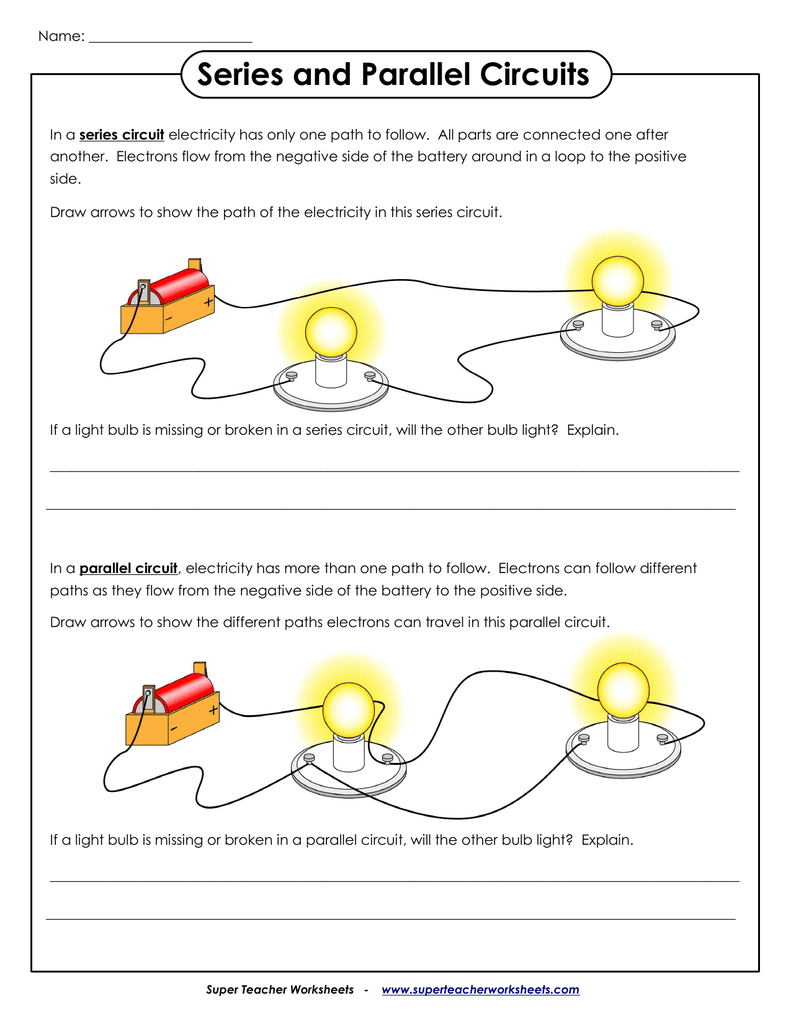
Draw Arrows To Show The Path Of The Electricity In This Series Circuit.
A) larger b) smaller c) the same. Understanding these facts will help you solve problems that deal with series circuits. Remember that in a series circuit:
Covers Part Of Aqa P2.3.2 Electrical Circuits.
The amount of energy used by a series circuit must equal the energy supplied by the battery. Series and parallel circuits in a series circuit electricity has only one path to follow. Electrons flow from the negative side of the battery around in a loop to the positive side.
Understanding These Facts Will Help You Solve Problems That Deal With Series Circuits.
Identify a series and parallel circuit, state the rules for series circuits, apply the rules to a circuit and calculate resistance, explain why and apply to more complex circuits. Series circuit current around the circuit does not change voltage across each resistor will have a voltage drop; Series circuit building worksheet answers 1.
Series & Parallel Circuits Tell Whether Each Picture Shows A Series Circuit Or Parallel Circuit.
What is the reading of voltmeter v1? To calculate total resistance, (add, use reciprocals). Thevoltagesuppliedbythebatteryisthe al voltageof thecircuit,andthe voltage drops across each resistor (is the same, adds up to) the total voltage.
The Current In Every Part Of The Circuit (Is The Same, Adds Up).
Circuit a circuit b b) if the resistors were light bulbs, how do you expect the brightness of the bulbs to be affected by adding more bulbs in series? In this circuit, three resistors receive the same amount of current (4 amps) from a single source. What is the equivalent resistance of the circuit?
A 20 Ohm Lamp And A 5 Ohm Lamp Are Connected In Series And Placed Across A Potential Difference Of 50 V.
Determine the total voltage (electric potential) for each of the following circuits below. All parts are connected one after another. To answer the questions in the practice section, you will have to use ohm's law.
Lesson Plan, Powerpoint, Worksheet To Be Used During Lesson And Series Problems With Answers.
E 1 w = 4 volts e 2 w = 8 volts e 3 w = 12 volts p 1 w = 16 watts p 2 w = 32 watts p 3 w = 48 watts. These questions & answers will help you master the topic! Draw a circuit diagram of the series circuit you constructed with two batteries (taped together as one), two light bulbs and a switch, if used.
These Devices Are Commonly Connected In A Circuit In One Of Two Ways, Series Or Parallel.
Every circuit must have the following parts: Most circuits have more than one device that receives electrical energy. Voltage of the circuit, and the the voltage supplied by the battery is the voltage drops across each resistor (is the same, adds up to) the total voltage.
Practice With Diagrams And Examples.
Series and parallel circuits worksheets, questions and revision for gcse combined science and physics. Then calculate total circuit current and the voltage drops and currents for each of the resistors. Series and parallel circuits worksheet use the chart to answer each of the following questions.
When Connected In Series, The Devices In A Circuit Form A Single Pathway For Electron Flow.
5) in the circuit shown below, voltmeter v2 reads 80. The voltage supplied by the battery is the _______ voltage of the circuit, and the voltage drops across each resistor (is. In this way, electrical circuits follow the law of conservation of energy.

Series Parallel Circuits Worksheet Answers

Series And Parallel Circuits Worksheet

Series Parallel Circuit Worksheet 1 Answer Key

Drawing Simple Electrical Circuits Worksheet Circuit Diagram

Electric Circuits Worksheets With Answers —

Circuits Worksheet Answers Linear Equations Worksheet Multiple —
Series And Parallel Circuits Worksheet With Answers Martin Lindelof

50+ circuits worksheets for 12th Class on Quizizz Free & Printable

Series And Parallel Circuits Worksheet With Answers Grade 9 IOT Wiring Diagram

50+ circuits worksheets for 9th Class on Quizizz Free & Printable

Worksheet Series Circuit Problems

50 Series And Parallel Circuits Worksheet

Series And Parallel Circuits Worksheet Answer Key Pdf

Series And Parallel Circuits Worksheets With Answers

Quiz & Worksheet Characteristics of Series Circuits
